Alternative Urban plans exhibition
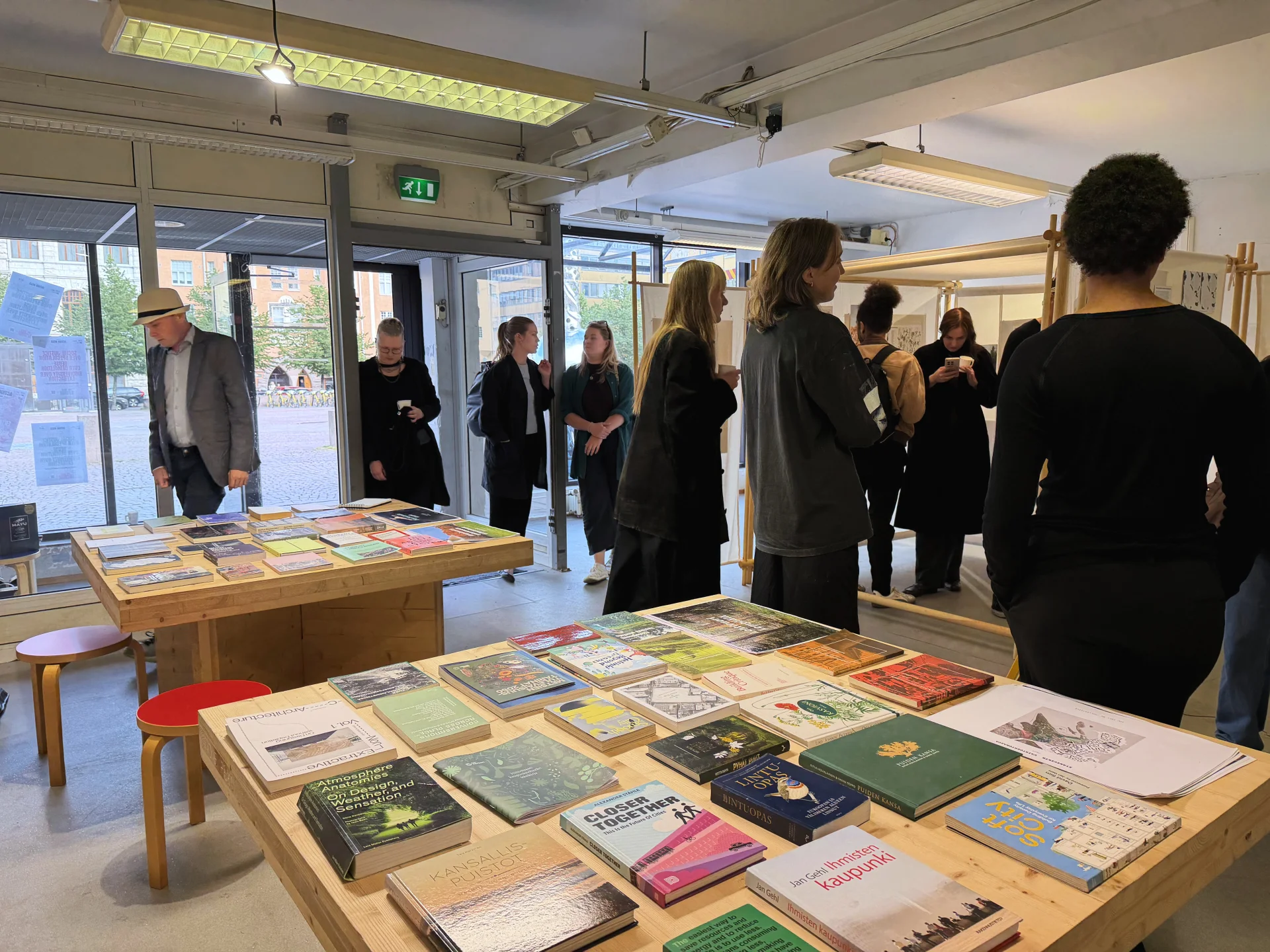
Alternative Urban plans was a week-long exhibition exploring different possibilities for the future of urban development and the role of nature in our cities.
The exhibition presented alternative planning proposals developed in collaboration with local activists. They invite us to imagine cities where urban forests and other forms of urban nature are recognised not as vacant spaces for development, but as valuable habitats and shared environments.
The exhibition asks a simple but important question:
“What kind of city could we build if we stopped treating
nature as space waiting to be built on?”
OPENING WORDS
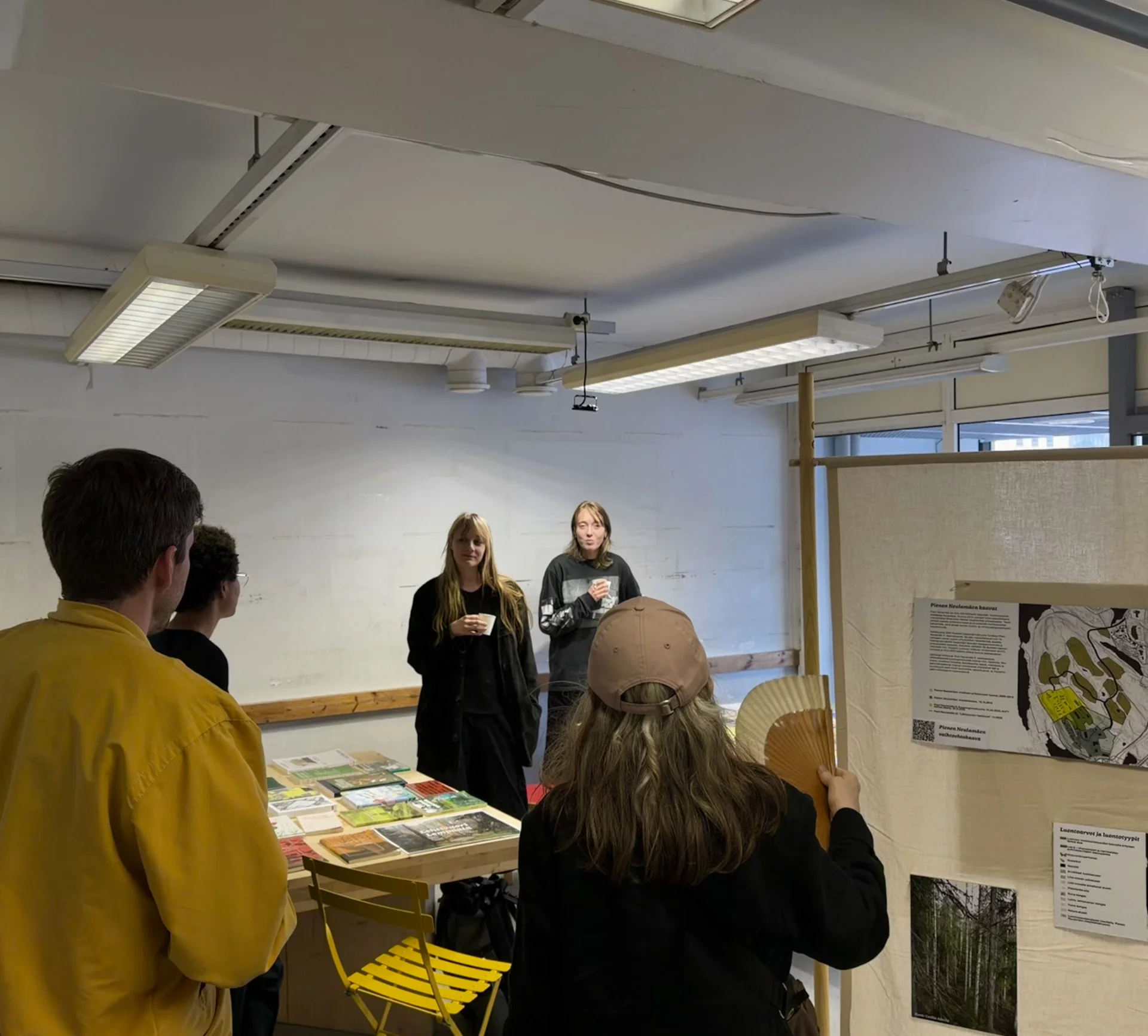
A very warm welcome to the opening of the Alternative Urbanplans exhibition.
The alternative plans on display were developed with funding from the Kone Foundation’s Metsän Puolella programme and in collaboration with local activists. The exhibition itself has been made possible by the Architects for the Future community.
The exhibition is part of the European Action Week, a series of events taking place simultaneously across 16 European countries, with more than one hundred different actions.
The principles of Action Week are clear:
Social justice, not speculation.
Reuse, not demolition.
Biodiversity, not destruction.
We are currently living through the sixth mass extinction. This means, for example, that wildlife populations have declined by approximately 73 percent over the past fifty years. Biodiversity is declining at an alarming rate, and one of the most significant drivers of this decline is the destruction of habitats as a result of land-use decisions.
At the same time, climate change is accelerating biodiversity loss and making nature increasingly vulnerable.
This summer, we have witnessed an extreme example of this in Europe, where extensive wildfires have destroyed vast areas of land. The total area affected by these fires is estimated to exceed the entire area of Uusimaa, with forests accounting for approximately one quarter of the affected area.
But biodiversity loss is not something that happens only somewhere far away.
It is happening here too — in our cities.
Humans are not the only inhabitants of a city.
Cities are home to countless other species, and urban forests are their habitats. At the same time, these forests are our local nature: places where we relax, exercise, and connect with the rest of the living world.
Nearby forests protect us from pollution, noise, and heat. Urban nature is therefore both a habitat for other species and an important part of our own well-being.
Urban forests can also be surprisingly diverse and old. Unlike intensively managed commercial forests, they have often been allowed to develop with a much greater degree of natural variation.
This is why urban nature matters on a much broader scale than any individual forest or park.
And yet, when cities are planned, nature is still too often seen simply as space that could potentially be built upon. New areas are zoned for construction in places that are already habitats for other species. Development takes place at the expense of nature, even when local residents strongly oppose the destruction of their nearby natural environment.
In Helsinki alone, this has already led to dozens of conflicts over local natural areas.
When we build a city, we are also deciding what other forms of life we allow to remain in that city.
Land use is not neutral. It is one of the most concrete ways in which we shape biodiversity.
The alternative plans presented in this exhibition therefore ask:
What would a city look like if we also recognised other species as its inhabitants?
And what could we achieve if we abandoned the assumption that nature must always make way for construction?
The loss of biodiversity cannot continue at this pace.
That is why we need alternatives.
Thank you.
- Heljä Nieminen & Siiri Hänninen
Book recommendations from
OUR LIBRARY
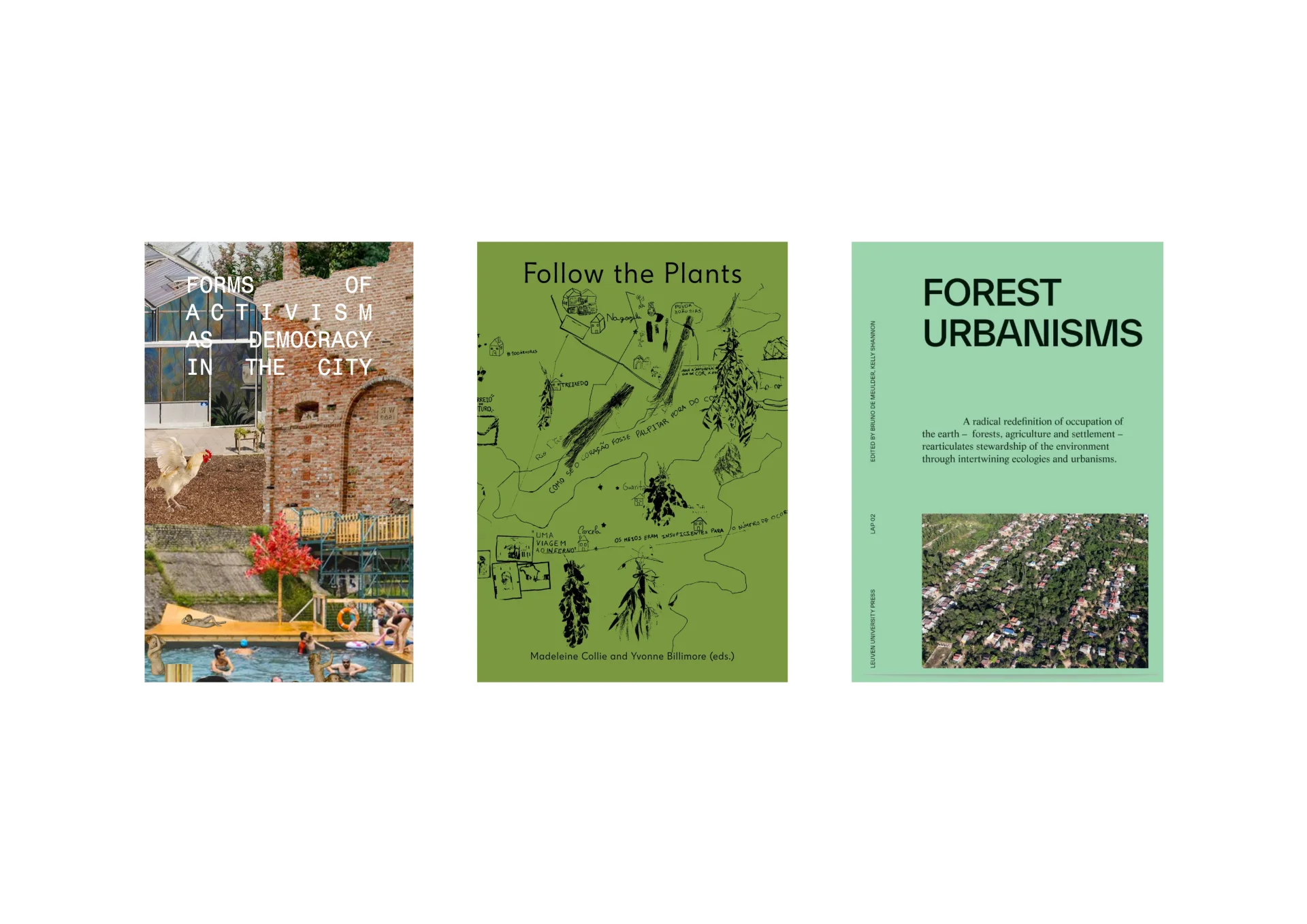
Forms of Activism as Democracy in the City
By Gideon Boie & Lieven De Cauter, in collaboration with Léa Denièle & Eneida Berisha
This concise booklet explores political, urban, and architectural activism and their role in shaping the city. It offers a useful introduction to how activism can become a form of democratic participation and spatial transformation.
Read the book
Follow the Plants
Edited by Madeleine Collie & Yvonne Billimore
An anthology of artworks, essays, dialogues, and research that asks what happens when we allow plants to guide our ways of thinking and working. The book explores plant–human relationships, interdependence, and alternative forms of ecological and collective knowledge.
View the book
Forest Urbanisms
Edited by Bruno De Meulder & Kelly Shannon
A collection exploring how forests, ecology, and urban development can be understood as interconnected systems. Forest Urbanisms proposes new ways of thinking about cities in which ecological processes are fundamental to urban life.
Read more about the book